
Butter cake recipes will always be disappointing if you don’t use the correct mixing method. While most people blame the oven for cake faults, the problem is not in the baking. The most common cake faults stem from mistakes made during mixing.
Mixing methods are the most important step in creating a great cake, no matter what the recipe.
The “Creaming Method” is used for high-fat cakes. In butter cake recipes, there is usually a great proportion of butter in the formula. Butter is fat. Shortening is fat. Creaming together fat and sugar is the first step in this “conventional” method of cake mixing
The most common mistake people make with this method is not incorporating enough air during this first step. The goal of creaming together fat and sugar is not only to create a consistent mixture, but to trap air within the fat which will eventually give structure and texture to the cake.
Correctly creamed fat is light, fluffy and smooth. If your butter/sugar mixture is coarse, dense, sparkles from grains of sugar, or is crunchy when tasted, you’ve got more mixing to do.
The second step in the creaming method is the most important. It can mean the difference between a moist tender cake and one that is tough and dense. While chemical leaveners like baking soda and baking powder help the cake rise, it’s the addition of eggs that prevent it from falling back down.
Step two includes forming an emulsification. Two unmixable items that are brought together are said to be “emulsified”. Fat and water don’t mix. But, egg yolks are the liason or emulsifying agent that will hold them together during baking. So, creating a strong emulsification is key.
When you add the eggs to the creamed butter and sugar, it should be in multiple stages, in a slow stream. Never add the next egg until the previous one is fully mixed into the butter. The butter/sugar mixture will appear wet and uncombined when the eggs are not completely mixed in.
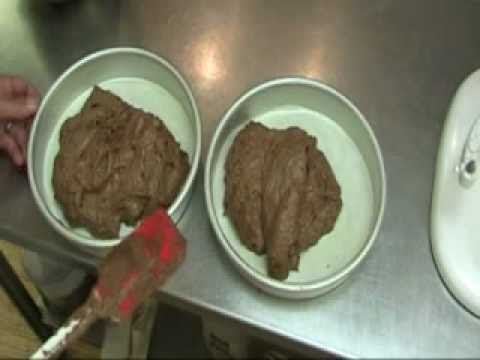
Since chocolate is fat, melted chocolate is added immediately after the eggs to be included in the emulsification process. You’re now looking at the beginning batter for a chocolate butter cake. You’ve created the foundation, now it’s time to give texture and structure to the cake.
The fourth step in the creaming method is to alternate the sifted dry ingredients and liquid ingredients until you have a smooth, spreadable batter. Sifting of dry ingredients is an important step because it too incorporates air, giving a lighter texture to the cake.
How do you tell when your chocolate butter cake is done? There are three ways:
1) Shrinkage – As the egg and flour proteins coagulate, they shrink and pull the cake from the sides of the pan. One clue to a completely baked cake is a slightly smaller cake than the pan.
2) Springage – Press on the top of your cake slightly with a finger. If the cake immediately recoils, it’s done. If a fingerprint indentation is left, you’ll need more time in the oven.
3) Stabbage – Stab it with a toothpick. If it comes out dry, the cake is finished.
Repeating the necessary steps in the creaming method will give you the best results when making a chocolate butter cake, pound cake, or even cookies from scratch. Each step of this process builds on the previous. Butter and sugar are creamed to trap air. Eggs are added to create an emulsification.
These are the building blocks of a great cake that has nothing to do with what happens in the oven.
Discover a simple 5 step plan to save time, save money, explode your confidence and conquer the holiday kitchen this year with my FREE Holiday Cooking Success Class.
Click HERE to hold your spot!

What happens when I mix a liquid with my creamed butter mixture and it turns into something liquid buttery something
Hi Mia!
Fat and water are two unmixable items. If you were to mix a liquid with creamed butter, you’d get….liquid and butter. They would not mix together without an emuslfying agent like egg yolks. That’s why in many cookie or muffin recipes, you cream the butter and sugar, add eggs, and THEN any liquid. The eggs act as a liaison to bring together the two unmixable items. If you want to add liquid to a formula, it is usually done at the very end.
Videos about emulsification: “How To Make Salad Dressings With 3 Ingredients” or “Make Mayonnaise Yourself By Mixing Two Unmixable Items“
Hi Chef Mohr, Thank you for helping the rest of us in the kitchen. For health reasons I have pursued homemade broths, boullions, stocks, soups, stews, etc. The only thing I have discovered, beyond the fact that there are innumerable recipes for this type of cooking, is that it seems the product has to cook for over five hours on the stove before it breaks down and actually begins to smell good. And “breaks down” is the only way I can describe it. What’s going on here and what can you tell us about this type of cooking? Also, is there a better way to do all this?
Hi Bobbie!
Briefly, what gives your stocks body is the gelatin from the bones of the animal. Beef stocks should be simmered for hours, usually overnight. Chicken and Veal stocks for about 3 hours, fish fumet for an hour. This is so that the moist heat can “break down” the marrow, turn to aspic and gelatin for the correct texture of the stock.
You can speed the procedure by chopping bones into consistent, smaller pieces. But, better not to rush excellence.
Chef Todd, Why do some recipes say to cream the fat with sugar,add eggs and THEN: add flour mixture first and add liquid, add another flour, add liquid and final flour mix and last of liquid. They have broken down the dry and liquid into 1/3 parts starting with dry and ending with dry.-Where do they get the last dry if it were all broken down into 1/3 ratio? Never could get that!. I finally broke the last flour into 1/2 of what was left and ended with the dry. Why is it important to end with dry? This is a Martha S method I used.
Thanks.
Bye the way, your course is great and I really appreciate knowing why I am doing what I was always told, but no explanation given to me–guess they did not know why, only followed what someone told them to do. This is not me…why, why, and why-that’s me
Carolyn B
Hey Carolyn!
Happy New Year!
The method of alternating liquid and dry ingredients in mixing is used when the formula has a larger percentage of liquid.
You’ll notice that the butter cake recipe from this week’s blog simply added all the sifted dry ingredients at once. This is because there is no liquid in this formula other than the eggs.
In the two-stage method, liquid and dry are alternated because of the amount of milk in the formula. Alternating the wet and dry ingredients gives you a more consistent mixture, and helps with the emulsification provided by the eggs.
If you dumped all the liquid into a mixing bowl, then dumped all the flour, you could wind up with gelatinized flour balls in your mix, yielding pockets of dry flour in the finished cake. Adding liquid then flour allows the two to mix consistently and have the egg proteins suspend the liquid within the fat rather than having liquid surround the fat.
It’s the method that’s most important, and creating a consistent mixture, incorporating air, and emulsifying fat and liquid are the goals of cake mixing.