
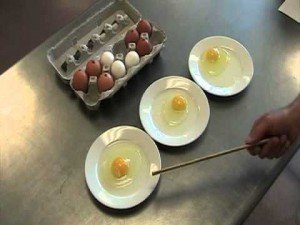
I’ve gathered three types of eggs for today’s Great Egg Test. If you missed the last blog post, there’s still an opportunity for you to see the Farm Eggs Challenge from the Downtown Baltimore Farmers Market.
I’ve just returned from there after interviewing two egg providers. The first raises their hens in cages and feeds a corn and soybean meal. The second feeds a vegetarian diet and the chickens are raised in hen houses. Both treat their animals in the kindest, most humane fashion. Each explained how they give the birds twice the room required by law.
But, the egg test is not about passing judgment on the treatment of animals, that’s for another day. I’m concerned with the end-product. I want to know if a cage free egg is actually better than one from a hen that lives in a cage. I want to know what the freshest product, the one that will give me the best nutrition and flavor. This is very important that I use the best ingredients and always cook fresh.
I’ll also bring in a third contestant, a plain white egg from the grocery store. I have no idea of its origin or how its mother lived. Since most people get their eggs from a display case and not the farmers market, I’ve chosen to bring in the mass-produced egg as a comparison.
The first event in my Egg-lympics is the spread test. After cracking each raw egg onto a plain white plate, I notice how it fills the surface. The more an egg spreads on the plate, the less fresh it is.
A truly fresh egg is measured by how high the yolk sits atop the white. Instantly, I notice a difference between both farmers market eggs and the grocery store one. The mass-produced egg spills like water onto the plate and rolls around as I pick it up to view. The yolk is spread almost flat and has a dull yellow color.
The egg that came from a caged hen being fed corn and soybean gave a much better display. The bright yellow yolk displayed a high arched dome sitting on the jiggly albumen. The egg still spread to the edges of the plate, but did not slide around like it was in water. It’s clearly a fresher egg than the grocery store version.
The third contestant is the cage-free bird that eats a vegetarian diet. This egg has the darkest yolk, more orange than yellow. The yolk perches on the egg white like it’s sitting on a throne, up straight and proud. It does spread more than the caged egg, but the yolk is stronger.
Event number two in this egg test is the frying test. As I put each egg into its own omelet pan, I notice immediate differences. The grocery store egg flattens as it cooks and the yolk becomes a cloudy yellow. The cage-free egg cooks nicely, the yellow yolk sinking a bit into the white that quickly dries out.
The winner of the cook test is the cage-free egg. Once cracked into the pan, it retains its original position, not spreading, now weeping. It looks like a picture of an egg in a magazine, with three tiers leading to the orange yolk. The white stays moist and shiny. It clearly looks the best cooked.
However, it’s really the flavor test that I’m most interest in and the grocery store egg is again last in the race. It tastes like water. The yolk is mealy and flavorless. While egg whites are not usually known for their flavor anyway, this one has LESS flavor than water.
There’s a clear difference in flavor between the mass-produced egg and both eggs from the farmers market. The local eggs both have a much more pronounced flavor. There’s an “earthy-ness” to both eggs that the factory egg just can’t match.
From this point, it’s really just a matter of your personal preference. For my palate, the cage-free vegetarian-fed egg had a creamier yolk, a moister white, and a more complex flavor that gave me a sense of the farm they were raised on. The eggs from caged hens was excellent also, just not as much complexity of flavor to my tastes.
So, who wins the Great Egg Test? You do. Start buying local eggs from your farmers market. It will be your gateway into seeking out wholesome, fresh ingredients that benefit your community, your farmer, your earth, and your body as well. Buy local, buy fresh and you’ll always have the best ingredients.
Discover the difference between how professionals and home cooks are taught in my next
FREE Webinar Workshop
Claim your FREE Spot for the next webinar session by CLICKING HERE

Thank you for this awesome blog!! I agree with the eggs from hens raised on grass are much better. Have you seen this study on the nutritional benefits? http://www.motherearthnews.com/real-food/free-range-eggs-zmaz07onzgoe
I do have concern on the emphasis on “vegetarian fed” tho. Vegetarian fed may not provide appropriate nutrition for omnivore chickens (especially in winter when there are few bugs to eat). We add sustainably sourced fish meal to our poultry feed which rounds out the amino acids available to the bird and allows for a more balanced ration and increases hatch ability as well as texture and flavor of the eggs (we hatch our own chicks on farm).
Egglands best was reciently chastized for saying their eggs were better. any comment? What can those of us do when we are stuck with grocery store junk? They dont tell us how they were fed.
Hi Jay!
I didn’t hear of the Egglands claim. “Better” can be a relative word. I’m sure they think their eggs are better in a way I don’t really care about.
There are “food deserts” all over the US, places where no grocery exists or where just the big chains are a monopoly. In many places, it takes a greater effort to find the most wholesome foods.
When I was a kid, we’d drive to the “country” and visit a farm most weekends. Sometimes it was Apple picking, Strawberries, or whatever was in season. This is a great habit to return to. Take the time with yourself and your family to seek out the better food alternatives and make the time to improve your health and well-being with better fuel.
Thank you Chef Todd for another reminder to choose fresh and choose local. This video is a good example of why we should choose our food carefully. It isn’t about cost, it’s about nutrition. Many folks struggling with weight management think that the problem is just food quantity. In reality it’s also the quality of food that is important. Eating cheaper foods with low nutrition value actually creates food cravings and a desire to eat more because of missing nutrients. When switching to higher quality foods, after a few weeks, the consumer will eat less and the expense of food will go down. It is well worth it to purchase better quality foods, the additional costs of not doing so can be very expensive in the long run.
Well said, Bobbie!
It saddens me that the ONLY way food is marketed in the grocery store is by price. “Chicken, $.69 a pound.” It says nothing of the quality or source of the chicken. It assumes that chicken is chicken, only the price changes.
Having grown up on a farm I noticed a few things about eggs.
it’s not only food it’s also the availability of sand for them to aid in their digestion and oyster shells for calcium. Chicken’s need to be able to scratch around and find what their gizzards crave.
The other factor that goes into this is the type of chicken.
Not all chickens are equal. Even the age of the chicken matters.
Brown eggs are from young chickens and several different varieties. There’s even a chicken from New Zealand that have bluish green eggs but have very dark yolks. What we get from the store is usually from some kind of leghorn. Organic egg farms will have a variety of breeds. I liked Rhode Island Reds.
Thanks for contributing some additional useful information, Mark.
The second farmer I spoke to mentioned the “egg-line” of his chickens, like a pedigree.
Without a doubt, farm fresh eggs are superior to supermarket provided eggs; the yolks are richer in color, have a well-rounded flavor, and taste like an egg should taste. If you typically fry your eggs to oblivion, save a few dollars and go for the supermarket eggs, but if you want great flavor (and there IS a noticeable difference), spend the few dollars more for egg-zactly the flavor you desire.
(Great egg-zample, Chef!)
A very good presentation. I like the way you explain the differences and leave it up to the individual to decide which they want. I agree to go the local farmers market and support you local individuals.
Thanks again Betty
Thanks for your kind comments, Betty. I’m glad to hear from so many people that have tasted the difference between global and local foods. We just need to convert more!