
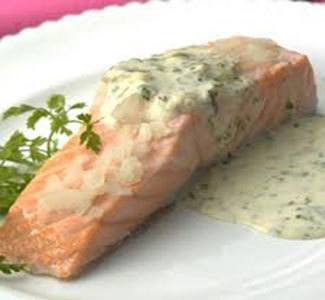
Even an American Idiot can learn there’s more than one method to poaching salmon. I’ve come to the realization that neither MTV nor Food TV are doing their jobs these days. MTV doesn’t play much music, and Food TV doesn’t teach anyone to cook.
I’ll accept the challenge that’s been ignored by both media outlets. I’ll use their leftovers, their scraps, their b-sides to create a new and exciting combination of cooking and music. It’s my Food iPod.
Green Day is cranked in my ears, and gas is blazing on the stove to explore two ways to use dry and moist cooking methods on delicate fish.
Poaching Salmon is an excellent cooking method because of the delicate nature of fish. When you cook items in softly simmering liquid, it’s considered poaching. The advantage of this type of cooking is that you can add flavor and retain moisture without a delicate product toughening from over cooking.
However, there’s a big difference between boil, simmer and poach. Most people mistakenly believe that anything cooked in liquid should be at a violent, rapid boil. This is no more true than cooking anything in your oven at 500 degrees Fahrenheit. There are temperatures in your oven below 500, and there are temperatures of liquid below violent boil.
Actually, “boil” is not a cooking method. Not in my kitchen anyway. Nothing should be boiled in the kitchen. Boil is 212F/100C and breaks up delicate items with its violent motion. It should be avoided for everything other than assuring your water is safe after a disaster.
“Simmer” uses temperatures lower than boil, at 180F/82C and has soft bubbles around the outer edges of your pan. Most items in the kitchen are simmered, not boiled.
“Poach” uses temperatures even lower than that, at 165F/71C and is the best way to cook fish and vegetables because of the relatively low temperature that prevents over-toughening, and the delicate nature of a cooking liquid that shows no bubbles, and barely a motion to it.
The down-side of poaching salmon is that the cooking liquid will never reach the 320F/160C temperature necessary to “caramelize sugars”, giving an attractive eye-appeal and crunchy crust to the fish.
We can over-come this drawback, and still take advantage of the benefits of poaching salmon in liquid to retain moisture. This is done with a combination cooking method. A piece of salmon can be sautéed first in a very hot, dry pan to add color and visual appeal. Then, you can add hot liquid to the pan and continue the process that gives more moisture and flavor.
There’s more than one method to consider when poaching salmon, like there’s more bands than Green Day on my iPod. I have a choice in food and music. One method will give greater moisture, but less color and texture. The other method will give great eye-appeal, but you’ll sacrifice some of the moisture with a dry cooking process.
Do you have any requests for the Food iPod?
Leave a comment below with a song and a food. I’ll hit “shuffle”.
What’s the #1 Chef Secret for Creating Amazing Meals at Home? online cooking classes.

Get the 5 Chef Secrets DVD and a FREE 14 day trial in WebCookingClasses.com
Poaching Salmon gets easier when you have online cooking classes
yes, please get rid of the music…..definitely not what I am looking for……I can go to YouTube/iTunes for that……..we all having cooking in common at this site —- NOT MUSIC !
The Food iPod was an experiment ahead of its time, perhaps.
To chime in with Ward: I’m on Week 33 and the classes themselves are non-musical, VERY entertaining (thanks, Chef Todd) and, most importantly, excellent at imparting a real understanding of cooking. I started as a complete novice, barely able to painstakingly follow the instructions of a few recipes – but now cooking is fun and creative and I haven’t used a recipe in over six months!
I hope the MTV format brings a lot of people into the cooking classes – and how about some Moody Blues or King Crimson?
To Mary:
Hang in there because you’ll love what you learn in these classes. I’m starting week-42, have been a chef for many years and owned my own restaurant but still learn something from every lesson Chef Todd teaches.
The iPod thing is just an experiment; he’s only done a couple of them as an “addition” to his normal classes. If you don’t care for the iPod lessons, don’t listen to them — the topics will be covered in the regular classes anyway. I’d hate to think you are giving up on an excellent learning method just because of an attempt at trying something different (It will probably be short lived).
I have no connection to Chef Todd’s businesses so don’t take it like I’m trying to bend your arm, I just know you can learn everything you’ll need to know in the kitchen by sticking with these excellent classes. Pleeese don’t deny yourself a learning experience you can use forever — isn’t that why you signed up in the first place?
Best of luck in your lessons, you won’t regret having taken them.
Ward
Again, I must say I’m DISAPPOINTED. I didn’t subscribe to hear MTV, or have it simulated. I don’t watch, or like MTV. I MUST AGREE with Vikki, the music MUST GO!!! You’re taking away from the learning process, the skills and knowledge you’re sharing. I subscribed because through all my searching for learning how to cook (without using a receipe), and becoming good at it, I found you; but if you’re going to continue with the music I’m going to have to cancel my subscription, and find someone else. I enjoy the way you train, in your unique fashion. I like the way you let us see (closey) what the food should (or should not) look like; your explanations are very informative, and the reasons ‘why’. Keep that up! ACCENTATE THE TRAINING, ELIMINATE THE MUSIC!
Hey Mary!
The Food iPod thing is just a quick experiment. It won’t last. I just wanted to try something new.
Also, the free blog videos are meant to reach out to many different types of audiences to arouse curiosity in WebCookingClasses. They’re not meant for everyone. Many people like the Food iPod thing, many people don’t.
You’re fortunate that you’re a member of WebCookingClasses, because you get access to all the best instructional videos and only have to put up with my experiments for a few episodes. Those that aren’t members only have access to the free blogs.
Thank you for being a member. I take your comments seriously and will return to “accentuating the training”.
Wondering if we saute the poached salmon, would it be the same as sauteed salmon+moist method?
No, Pete. If you poach the salmon first and THEN try to saute for color, it won’t work.
The proteins in the salmon coagulate at 165F, that’s when it’s cooked.
If you try dry heat on a poached product, you may get some burned color, but you’ll have a very rubbery fish.
It works! Now we’re jammin’!!
I like the sizzle-jam idea of the iPod as long as you keep it short and include your narrative below the video to explain what’s going on.
Good times!
I got the music on my computer, but don’t like it with the cooking…I enjoy listening to you talk and explain things….The music drowned things out, and took away from the learning…
Thanks for the comment, Vikki.
I thought I’d try something new.
You won’t be able to keep me from talking for too long! lol
I LIKE IT. NICE! THANKSS